Baroque on Mars: a four-frame study in art direction
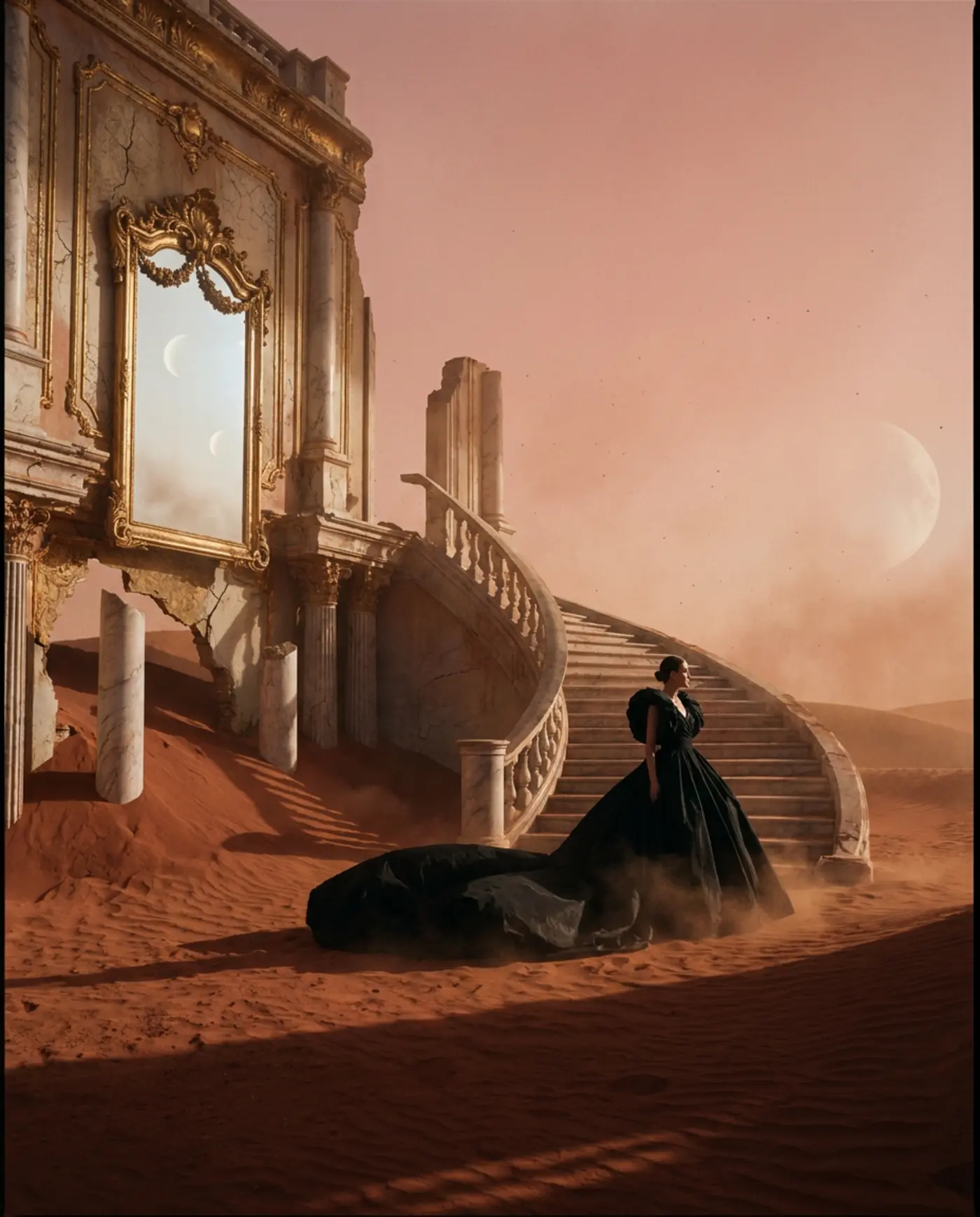
A baroque palace buried on Mars, and someone still dressing for the occasion.
This is a four-frame concept series — no client, no brief, no brand. It exists as an exercise in one thing only: holding a decision across a sequence. Below are the rules I set myself before generating a single image, and the four prompts in full.
The system
Before anything else, four constraints. Everything that follows obeys them.
One palette. Oxide red, salmon, tarnished gold, deep black. Nothing else is allowed into the frame. Not a blue, not a green, not a chrome highlight. A palette is only a palette if you refuse things.
One light. Low and raking, always. Never overhead, never diffuse. The long shadows are the second subject of every frame — they do as much compositional work as the architecture does.
Dust in all four frames. This is the load-bearing decision. Suspended dust acts as a natural diffuser, softens the falloff, and catches the low sun so the air itself becomes visible. It is also the single thing keeping the series from reading as science fiction: sci-fi renders are clean, and dust is what makes an image feel photographed.
The gown is never clean. Dust settles into every fold of the taffeta, into the seams, on the skin. A pristine couture gown in a desert reads as a composite. A dirty one reads as a story.
The sequence
Wide, then her, then the detail, then absence.
The first frame establishes scale — the ruin is enormous and she is small inside it. The second gives her authority: seated, frontal, unbothered. The third goes down to the hem and the dust, because a sequence needs one frame where you can almost feel the material. And the fourth is the one that makes the series work: she walks away, and all that is left is the train’s trail across the sand.
Three frames of ruin, one of absence.
That last frame is the whole method in miniature. A sequence isn’t four good images — it’s one decision repeated three times and broken once. The repetition builds the world; the break is what turns it into a story.
The four prompts
1. The ruin
Wide cinematic fashion editorial on Mars: an immense baroque palace half swallowed by rust-red dust, broken marble columns and a grand curving staircase rising out of the desert into nothing, gilded mouldings tarnished and cracked, an ornate gold mirror still hanging on a fragment of standing wall reflecting empty sky; a woman in a sculptural black taffeta ball gown with an enormous train stands at the foot of the stairs, tiny against the ruin, dust drifting around her hem; salmon-pink sky with two pale moons, low raking alien sunlight casting long shadows across the oxide sand, suspended dust softening the air; shot on medium format film, fine grain, palette of rust red, salmon, tarnished gold and deep black, majestic and melancholic, hyper-detailed textures of marble, gilt, taffeta and dust —ar 4:5 —style raw
2. The throne
Cinematic fashion portrait on Mars: a woman seated on a broken baroque throne half buried in red sand, wearing a sculptural black taffeta gown with structured shoulders and a high collar, dust settled in the folds of the fabric, gloved hands resting on the carved armrests, chin lifted, gazing directly at the camera with imperial calm; behind her a fragment of frescoed ceiling collapsed into the dust, gold leaf still catching the light; low raking sun from the side, salmon sky, fine red dust hanging in the air and glowing where the light hits it; shot on 85mm lens, medium format film, palette of rust, salmon, gold and black, hyper-detailed textures of taffeta, carved wood, gilt and dust on skin —ar 4:5 —style raw
3. The hem
Extreme close-up on Mars: the hem of a black taffeta ball gown dragging across rust-red sand, the stiff fabric caught mid-fold with a fine layer of red dust settled into every crease and the sharp edge of the silk catching low sunlight, and beside it a fragment of gilded baroque moulding half buried in the sand, its gold leaf peeling and oxidised; individual grains of red dust visible, a thin drift of powder blowing across the fabric; razor-thin depth of field, macro lens, medium format film, palette of black, rust and tarnished gold, tactile hyper-detailed textures of taffeta, gilt and mineral dust —ar 4:5 —style raw
4. Two moons
Wide closing shot on Mars at dusk: the vast rust desert stretching to a distant horizon, the silhouette of the ruined baroque palace small on the left, and the woman walking away from camera across the empty plain, her enormous black train sweeping a long clean line through the red dust behind her; two pale moons rising in a deepening violet and salmon sky, the last low sun rimming her figure in gold, everything else silent and monumental; shot on medium format film, fine grain, palette of violet, salmon, rust and black, epic emptiness, one figure and one trail —ar 4:5 —style raw
Notes for anyone rebuilding it
If your version drifts, it will almost always be one of three things. The palette let something in — a cool highlight, a blue sky, a green tone. The light went soft or overhead somewhere in the middle of the series. Or the dust disappeared, and with it the atmosphere that was holding four separate images together as one place.
Consistency is not a bonus in a campaign. It is the requirement. Everything else is decoration.
Concept work, produced entirely in the Magnific suite.